Showing posts with label Chilean. Show all posts

Tuesday, November 25, 2014

Here come the Thanksgiving pinot noirs


-- among which, and starting off in no particular order, is 2010 Llai Llai, from Chile's Bio Bio Valley.


In Llai llai, pinot noir's distinctive earth-tar-hung game-forest floor-musk aromas lean more toward (very clean) forest floor and wholesome chewy bread crust; be forewarned the delicate, fresh berry flavors that follow will not last beyond the first night, so if you open this for Thanksgiving, drink up. That seems to be true for many of the good, inexpensive holiday pinot noirs I have been lucky enough to sample lately.

Llai llai pinot noir retails for about $12 to $15.


The next two are from R. Stuart Winery, McMinnville, Oregon. Big Fire is their more approachable pinot, R. Stuart Autograph the "step-up" label. I preferred the latter.

2008 Big Fire pinot noir

very pale, clear red
earth, fresh, faint floral --
very light, very subtle fruit (too light?)
almost as gentle as water -- a little burst of acid and tannin at the end
will accompany any food


Retail, about $20

2008 R. Stuart "Autograph" pinot noir

All of the above, only this time a gray charcoal drawing colored in --
more berry-like fruit, more of a pinot's earth and musk
more acid, more body, more interest

Start here?

Retail, about $30.


The Crossings


Awatere Valley, Marlborough, New Zealand --

startlingly light, bright currant jelly color
that pinot noir scent -- earthy, tarry, "gamy"
light silky acidity, berries


... and very good with a baked short rib stew and garlic mashed potatoes. A pinot noir's musky delicacy can be as surprising as its clear, jewel-like color when it sloshes into the glass, especially if you have spent several weeks sloshing cherry-sweet malbecs, thick, black carmeneres, or chocolate-coated zinfandel blends (all the rage) into that same glass.

Which leads me to admit that, really, I am suffering an embarrassment of riches when it comes to the samples that nice people at wineries and winery PR firms send me. (Thanksgiving pinots is the theme of the latest shipments. Remember when I used to drop broad hints that I'd be delighted to be offered a sample one day? It's true, I am delighted.) Or, as my daughter complains when she ventures into the little pantry to get some comestible, and turns around and stubs her toe on yet another cardboard box -- "We're tripping over wine in this house." Followed by an equally frustrated  "...and we're tripping over cats," as one or other of our large furry roommates, absorbed in rubbing meaningfully against a human leg, trots away in alarm from a misplaced human foot. The pantry is where we keep the kibble, too, so of course the lords of the manor imagine any darkening of its threshold is all about that.

Absent a short rib stew with garlic mashed potatoes, will The Crossings pinot noir complement Thanksgiving? Yes, I think so. Delightful. 

Retail, about $15 to $20.

And finally, FogDog. They also make a marvelous chardonnay.


Bright lush color
Bursting, almost fizzy with strawberries --
typical musk or tarriness is not so evident
a little vanilla
Excellent -- pair it with something rich and creamy --

-- or your Thanksgiving turkey, of course.


Image from Freestone Vineyards

Friday, April 18, 2014

2013 Sottano chardonnay classico

Have you ever seen this on your grocery store or liquor store shelves? Perhaps not. It's one of those small-scale, graceful, toothsome wines from a fine maker who sells his product via a small-scale (graceful? toothsome?) distributor. Perhaps even an independent broker, about whom you, the buyer, wonder how on earth does he earn a living just from commissions? 


I don't know how he does, but selling Sottano chardonnay classico (there is also a cabernet, very good*) should help.

By the way I missed the lunar eclipse the other night, although I know what they are like. I stayed up once as a teenager to witness one from start to finish, a good six-hour process as I recall. Eventually the moon does turn a dark reddish color; more than that, it suddenly hangs there in the sky as a small three-dimensional object; you have the strange sense that now it is its right size, and that you could reach up and pluck it down. Then the shadow passes, the red tinge lightens to a yellowy ochre, and finally the moon emerges as usual, the bright flat little klieg-light disc that bloats and thins with a certain smug trickery from one month to the next. Very early in the morning these past few days it has loomed very large, glowing above a dark brown-ochre spring landscape that looks as if it was painted for the cover of an old Gothic novel: a mass of dim dark interlaced trees, the dark stubby feathered grasses of a dim sepia brown meadow, in the middle distance the dark block of sepia milk-washed air itself. A few last stars vanish, it seems, even as you look at them. The robins sing, timidly. They seem to be not quite sure the ghastly winter is over. The morning star, which I suppose must be Venus, glows in the east. Look as you may, you can't seem to find firm blazing and wintry Orion any more.

Lord Byron puts it well, don't you think? -- and even talks a bit about food and wine, too. We here at Pluot are very fond of opening great books at random. Here is Don Juan (Canto the Second, CLXX).

While Venus fills the heart (without heart really
Love, though good always, is not quite so good),
Ceres presents a plate of vermicelli, --
For love must be sustain'd like flesh and blood,
While Bacchus pours out wine, or hands a jelly:
Eggs, oysters, too, are amatory food;
But who is their purveyor from above
Heaven knows -- it may be Neptune, Pan, or Jove .... 

*Retail, about $12.


Monday, January 20, 2014

2009 William Cole Vineyards sauvignon blanc


Columbine Special Reserve, Casablanca Valley, Chile

strong "New Zealand" aroma -- is this gooseberry? 
grass -- kiwi peel -- something like very faint cigarette smoke -- 
mouth puckering acidity -- somewhat hard (even chewy?) finish

I do like my sauvignon blancs to be as New Zealand-ish as possible. It seems I can never find one as bursting with grapefruit as I'd like -- the hunt for them is akin, in the sphere of white wines, to my hunt for an agreeable chianti among the reds (I want them as horsy and gamy as possible).

Nevertheless this was very good -- a pretty successful return from the field, you might say. (Although to be fair, the quarry came to me, via a salesman's sample.) And which William Cole winery are we talking about? There is the William Cole vineyards, owned by William and Jane Ballentine, that makes cabernet sauvignons in Napa Valley's St. Helena, and there is the William Cole vineyards, owned by Chilean native William Cole, that makes all sorts of wines in Chile's Casablanca Valley. He is the one who names some of his wines "Columbine," after the software company he used to run in Colorado, whose state flower is the columbine. Ah, there we are.

So good with a hot summer night snack of crackers and fresh mozzarella cheese. Retail, about $10. Even better.

Sunday, January 19, 2014

2009 Valdivieso reserva pinot noir


It seemed to me wonderful, but I regret that my perceptions of it are the opposite of what the technical sheet included with it says. My notes read:

very light -- delicate -- 
a delicate fleeting earthiness --
all one -- no fruit stands out -- wine,

and wouldn't you know it, I thought I was on the point of profundity in underlining that last. Imagine! Wine, an integrated whole, a product unto itself instead of an anxiously teased out collection of favorite fruit basket and cookery sensations.

Alas, it seems I'm all wrong. Not only did the other adult at the table find strawberries, richness, and alcohol heat in the glass, but that technical sheet promises "intense aromas of fresh berry fruit, strong cassis character and strawberries with elegant sweet spices from barrel aging; full bodied." The alcohol level, by the way, is 14.5%. Now it's one thing to form "votre propre opinion" on wine, as the women at Video Tasting always gently exhort their viewers to do at the end of each two minute clip. (It's nothing to do with Chile, only do go there and practice your French.) But it's quite another to taste delicacy and fleetingness in a wine whose maker of twenty years' experience says he has made intense, spicy, full bodied, and cassis-like. Is the first dram out of any bottle not to be trusted to represent the whole contents? Is this why God made decanters and air? Has my palate been burned out by years of eating too many dark chocolates and too much cinnamon toast, too heavy on the cinnamon (this is a family joke)?

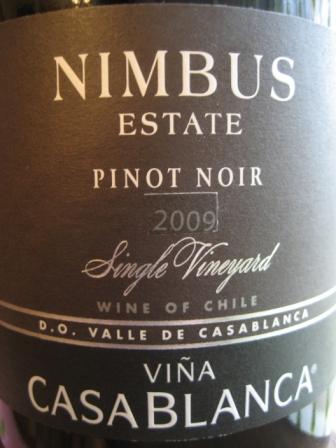
Anyway, of this Valdivieso certainly I can murmur "je vous le recommend," as the French women usually do of everything they try in their videos. I will also further promise to pay better attention and not get quite so far off the reservation, if I can, with Chilean blogger-tasting wine number 2. It will be a 2009 Vina Casablanca Nimbus Estate Pinot Noir, from Casablanca Valley. We won't even look at the technical specifications yet, shall we? "Au revoir."

2008 Cono Sur Ocio pinot noir


Even before decanting, delicious. Scents of spicy taffy and licorice waft up from the bottle. In the glass it's a lovely light clear jelly red. On the tongue -- as smooth as satin, earthy in aroma, gentle acidity and dryness at the end that make you slaver for another sip, and more dinner. Wonderful.

SRP -- that's retail speak for Suggested Retail Price -- $65.


2009 Vina Casablanca Nimbus Estate pinot noir


color: near black, cranberry-purple
scent: wet forest floor -- cherries 
drink it: absolute silk -- ohmyGOD this is good
very dry finish following earthiness and un-nameable fruit 
integrated -- wine (not a fruit basket)
touch of butter and acidity at end 
half an hour later, caramel

The technical information provided tells me that "after alcoholic fermentation, the wine was racked to French oak barrels to complete the malolactic fermentation, and remains [sic] for 10-12 months."

That, in turn, explains the third line of my overlong tasting-note haiku: the absolute silk, the calling upon God, etc. Malolactic fermentation, done by friendly bacteria rather than yeasts, is what transforms the sharp, green-apple malic acids in a wine into softer, milk-like lactic acids. The process makes wines that can be called variously "approachable" or "fat" or indeed "silky." Malolactic fermentation is responsible in large part for the difference between "bosomy" California chardonnays and the throat-scorching acidity of that Puligny which puzzled us not too long ago; and I would bet it's largely responsible for the difference between this Chilean pinot noir -- cool climate red though it is -- and one particular French cool-climate burgundy which, I'm sorry to say, I didn't like at all. I tried it months ago and put the experience aside in, well, puzzlement. As follows:

2007 Bouchard Père et Fils Réserve Bourgogne pinot noir


graceful raspberry aroma -- very light 
silky -- very acidic -- 
needs a creamy meal 
o.k.

I'm sure Bouchard Père et Fils deserves far better than this, but until one learns to appreciate French wines' exacting acidity levels, I suppose the best one can do is to be honest about how difficult they can be to enjoy. And mind you, this example is a modest-priced wine meant to be, I am sure, as approachable as may be to the American palate so fond of Lodi (California) fruit bombs. Still. We mustn't forget the upside to a scorched throat and flames shooting out the nostrils, even after a sip of something the French offer us as, ahem, fat: just as the Puligny which puzzled us perhaps should have been aged ten years before opening, this Bouchard Réserve pinot noir may have come my way far too soon as well.

Which, in turn, reminds me to double check the technical sheet for the delectable Nimbus Estate pinot noir. Did I read something about? -- yes, there it is. "Aging potential: between 5 and 8 years." 

Now wait a minute. I've tasted French acidity, and I've tasted Chilean acidity. And I dare to pronounce, there is no way Nimbus is going to last eight years, possibly not even five. It's delectable now. Drink it now.   

Retail, about $20.
Bouchard Père et Fils Réserve pinot noir, retail, about $20.

Saturday, January 18, 2014

2008 Santa Rita Medalla Real carmenère (single estate)

It's (almost) time once again for the Wines of Chile live blogger tasting, scheduled for Thursday, October 13th. This is my third time being invited to take part, and I am glad not only for the invitation but also that the new theme is "Carmenère and Curry. " I have little experience with this grape. Come to think of it I have little experience with curry.

All eight wines selected are carmenères. I have taken the liberty a) of opening one bottle early and b) of opening the one that we happen to sell in our liquor aisle. It is Santa Rita Medalla Real, single estate, 2008, from the Colchagua Valley.


The reason I have small experience of carmenère is because I avoided them after finding I disliked the first few I tasted while working at Ye Olde Wine Shoppe. Glasses of carmenère at the time struck me as terribly harsh. My Esteemed Colleague then, with his thirty-five years of experience in the business, used to amaze me when he sold the wine to other newbies by comparing it helpfully to "easy-drinking, fruity reds" they might already enjoy. Like Beaujolais. I thought he was mad. Easy-drinking? "Gulpable" -- carmenère, this tough and iron-hard thing? And as far as I was concerned that went for Beaujolais, too.

 What a difference four years makes. Suddenly I find the wine to be easy-drinking, fruity, a little sweetly spicy and altogether pleasant. Gulpable. (Is it also time to rethink Beaujolais?) I look forward to trying the next seven.

Retail, about $15.


2009 Marques Casa Concha carmenère

Once again, I take a liberty with the wines shipped to me for the next Wines of Chile live blogger tasting, scheduled for this coming Thursday, October 13th: I open one early.  I include a picture, and I hope you will note the composition -- here you can vicariously enjoy the October sunshine on a fine Sunday morning, and glimpse the neighbors' cute blue house in the background.


Marques Casa Concha tastes just as my Esteemed Colleague from Ye Olde Wine Shoppe used to say carmenères do (we remember how I doubted him) -- fruity, bright, and easy to gulp, although this particular example, being number 7 of the eight in the big box from New York, is sterner, richer, and more glowering than number 3, the Medalla Real that we took liberties with already. The wines for the live blogger tasting are arranged in ascending order of seriousness and weight, so that to sample them with Master Sommelier Fred Dexheimer's guidance this Thursday is to progress from simplicity to complexity, thus learning more about carmenère. I promise I will do that, once I stop taking liberties.  

Formerly the information kit packed along with the wine samples has included rather in-depth material on the winemakers, their careers, their goals with this cuvée, the history of the various vineyards and wineries, and so forth. This kit eschews all that, in favor of a beautiful and photo-crammed booklet about traveling in Chile ....

So it is up to me to do my own research and tell you, very briefly, that at the bottom of the Marques Casa Concha label above -- the picture cuts it off -- the name Concha Y Toro is, of course, the familiar name of "Latin America's major wine exporter" and one of the biggest wine brands in the world. If you've bought those generous 1.5 liter jugs of Frontera malbec and chardonnay and everything else, you know Concha Y Toro. If you've bought Fetzer, you now know Concha Y Toro, since Concha Y Toro just acquired Fetzer (you follow me). If, like me, the first wine you really liked was Frontera's dry rosé, then you'll have a special affection for the label, and might even be peeved to learn that, contrary to what you have been told, yes they do still make it. It's delicious, all bursting with juicy tart strawberries and acidic red grapefruit, giving on to a bracingly dry finish. Good with almost anything. Wish I knew where to get it.

... now about the beautiful and photo-crammed Chilean tourism booklet. Having thumbed through it, and having seen the splashing fountains in Santiago, and the ski slopes in Valle Nevado, and the surfing at Pichilemu, having hiked Patagonia's otherworldly crags and green valleys, and seen the volcanoes and the rose-bedecked streets of Puerto Varas and the glaciers and the whales of San Rafael Lagoon, I think I can safely say I now have no deep need to go to Chile. Armchair travel can be wonderful. Lisa Medchill puts it well:


I learned that the French refer to [pleasure] travel as a way to “change les idées”—change your ideas. Granted, just because the French say it doesn’t mean it’s wrong, but in this case, I really think they’re wrong.

Case in point, a few years ago, yoga freaks everywhere seemed to be lugging their purple mats to India precisely to “change les idées.” I was asked along on several such trips but declined. India is no doubt fascinating and the people sound very nice over the phone but … thanks for asking and godspeed. As it turned out, the only changes in ideas I heard from returning travelers dealt with multiplying the recommended dosage of Imodium. The best idea was an advanced formula called Explodium. 

On the upside, I learned enough about India to close my eyes and convince myself I went there and never needed to go back. One imagined trip was enough. Really, it’s staggering how much you can learn about the world by avoiding it. Without moving a muscle, I know St. Bart’s is “so restful,” Machu Picchu “so transcendent” and the Masai “so cheerful.” I don’t see why I have to confirm it all firsthand. You’ve rated the hotels, reviewed the meals, described the felonious cab drivers … why see the movie? Which exposes another dimly lit truth: The high point of any trip is when it’s over. People like travel but they love saying, “I just got back from Uruguay.” With open access to exotic locales, travel has become a seedy form of exhibitionism, more something to recount than experience.

Her entire article, "The Middle of Somewhere: Why I Hate Travel," from the New York Observer of April 2008, is worth reading just for her grudging admission that visiting her own vacation home constituted a "not overtly horrific" trip. There is also this:


I like being home. The sweet habit of home holds life’s potential. Preferring to be available to my own life, I’m pretty sure news about an optioned screenplay won’t reach me in Tuscany. It doesn’t reach me at home, either, but at least here, self-delusion makes some sense. Other people may like being in the middle of nowhere. Not me. And my atlas shows maybe four places in the world that aren’t in the middle of nowhere.

All this is not a swipe at the beauties of Chile, still less a swipe at Chilean wine of course. I just happened to find Ms. Medchill's article the same week I took a look at the gorgeous travel brochure (they called it "Chile is Good For You"). It helped focus my ideas. I do so enjoy writers who can master that curmudgeonly-but-not-bitter tone. And she made the pictures speak to me with new meaning. All those people smiling happily as they skiied, snorkeled, clipped bunches of grapes from the vines, plastered Atacama mud on their cheeks, and raised their glasses in toasts to fun. I'll bet you couldn't wait to get home, I thought curmudgeon-ly. One lady is even smoking a cigarette as she stands on a boat and looks, smiling, at the lake. Aha! Nerves. Show me to my armchair, give me a glass of Chilean carmenère, and stand back.


Thursday, January 16, 2014

Wines of Chile live blogger tasting -- what we tasted

After the group portrait, a few details on the sauvignon blancs and chardonnays that we paired (well, some of us did) with our seafood, citrus chili pepper, citrus salt, and our Olave Chilean olive oil.


2011 Casa Silva "Cool Coast" sauvignon blanc; retail, about $25.

2011 Vina Los Vascos sauvignon blanc, Les Domaines Barons de Rothschild, retail, about $14.

2011 Cono Sur Vision Single Vineyard Sauvignon blanc, retail, about $15

2011 Vina Casablanca Nimbus Single Vineyard sauvignon blanc, retail, about $13

2011 Veramonte Ritual sauvignon blanc, retail, about $18.

(Missing here: 2010 Santa Rita Medalla Real chardonnay, retail, about $18. Mine tasted peculiar.)

2010 De Martino Legado Reserva chardonnay, retail, about $16.

2009 Concha Y Toro Marques de Casa Concha chardonnay, retail, about $19.


Briefly: note the 2011 vintages of the sauvignon blancs. "Vibrant young fruitiness" is the grape's "strong suit," as Jancis Robinson says (Jancis Robinson's Wine Course), which means it usually doesn't spend the months in oak barrels that chardonnays tend to do, and so comes quick and delectably fresh-tasting to the market. Our last wine of the evening, by contrast, Marques Casa Concha chardonnay, actually boasted the year 2009 on its label. Note also the relatively modest price points on all the wines -- though some bloggers balked at the $25 suggested for Casa Silva's Cool Coast sauvignon blanc, the first one out of the box. Perhaps the nice people at Wines of Chile wanted to dispense with any sticker shock right away. Besides, a Domaines Barons de Rothschild sauvignon blanc immediately following at about $14 begins to soothe the nerves, doesn't it?


Wednesday, January 15, 2014

Eight reds (all very good)

To load eight of them into one post might seem to give short shrift to all. This is not intentional; all really were very good and it so happened they all fell into my lap nearly at once. Now do they, in their baked fruits-and-vanilla richness and their "we're for grownups" tannic punch(es), come a bit close to defining the "global red"? Perhaps. Still, we won't complain. In no obvious order, I was privileged to savor:


2009 Black Stallion Estate Winery cabernet sauvignon


2007 Concha Y Toro Don Melchior cabernet sauvignon


2008 Concha Y Toro Terrunyo carmenere, Block 27


2008 Concha Y Toro cabernet sauvignon, Block Las Terrazas


2008 Trivento golden reserve malbec


2008 Beaulieu Vineyards BV Reserve "Tapestry" (a birthday treat)


 2010 Miro petite sirah (the sweetest of the bunch, I must say)


2010 Miro pinot noir

May I conclude with another picture from my garden? I tend to give you closeups because the whole view would look rather weedy. This is a peony. And a bon and delicious weekend to all.


Tuesday, January 14, 2014

2009 Cono Sur "20 barrels" pinot noir

Another select Chilean wine, another one "knocked out of the park" as they say.

Silky and elegant,
 tart tangy raspberries in a little cedar box. 

I'm beginning to think there is something to this whole single-vineyard/20 barrels/special care taken/passion/integrity/respect for the land thing.  


2009 Nimbus Estate pinot noir

You can't see, through the dark green glass, the mariachi band playing next door, nor hear the sounds of all the other neighbors' Sunday afternoon barbecue parties, and then the lawn mowers whirring. Nor can you taste or see either the disappointing dinner I made -- Julia Child's potée Normande, or "French boiled dinner," gad, boiled dinners are over-rated -- or the disappointing cocktail before that. Café San Juan. Why did I waste a jigger of good rum on a drink made with coffee, ice -- and lemon?

Thank heaven the wine was good.


Retail, about $16.

Monday, January 13, 2014

2011 San Pedro "1865" single vineyard sauvignon blanc

Oh my goodness -- dear things -- what, what an excellent wine. The aroma heavenly, like chives and freshness and grass and a spring day and something meaty as well. The taste, all of the above plus a sturdy body too. Perhaps somewhere in here is the property or flavor that wine labels, and wine writers, mysteriously call "minerality."


Now this is a Chilean sauvignon blanc (we are stealing a march on this week's Wines of Chile live blogger tasting), so it will not actually hurl limes and grapefruits at you, as New Zealand examples of the grape do. It will also not merely splash buckets of lukewarm water at you, as California sauvignon blancs tend to do. Instead it will be your firm (minerally?) friend, standing as it were by an open window snipping chives, a cigarette dangling surprisingly from its mouth as it helps you prepare your braised and garlic-sprinkled pork chops, buttered fingerling potatoes (gracious, they're purple all through), and buttered broccoli. If you wish to invite it afterward to a little midnight snack of crackers, fresh mozzarella, and pesto, it will not object.

2012 Albamar sauvignon blanc

William Cole, whose Chilean wines we have met before, makes this "Albamar" (meaning sunrise-ocean) sauvignon blanc and makes it pretty strong stuff, it seems to me. No juicy kiwi and grapefruit or delicate lashings of acidity here, but rather a sort of dry-mouthed, tart green apple wallop on the back of the head, from your Granny Smith herself. "Bone dry" the website says. That it is. Make no mistake, very delicious.


Retail, about $12.

Wines of Chile -- 2010 Emiliana "Novas" Gran Reserva pinot noir

The people who run the twice-yearly Wines of Chile live blogger tasting have been so generous this fall (this spring, in Chile) -- twelve wines sampled instead of a mere eight -- that I think I should offer a bit of time to each. Here we enjoy our fifth of the case, Emiliana's "Novas" pinot noir. Novas, the Latin for new, and the starry theme on the label both refer to the appearance of bright new stars in the heavens, and other wondrous and interesting things. The wine is, quietly, what pinot noirs tend to be: a whiff of smokiness, a taste of olive brine, a mouthful of fresh tart raspberries. Delicious.

I write this in an unusually quiet house. The young folks are out on a zombie safari hayride. I ask you.


Retail, about $14

Wines of Chile -- 2011 Casa Silva "Cool Coast" sauvignon blanc

Pucker up!  It's all tart, fresh lemons, and it swirls in the glass like silver ... I'm sorry to say I missed a good deal of the Wines of Chile live blogger tasting last night, because we all got home from work rather late and harassed, and everybody seemed to have pressing stories to tell which outranked affairs in Santiago. Still. The wines have been so very good.. 


Sunday, January 12, 2014

2009 Koyle Royale carmenere

Green pepper, smoke and -- could it be -- very rich, dark roasted apples?

We wax poetic. Anyway, it is delicious. Another fine sample from last week's Wines of Chile Live blogger tasting. We are almost beginning to think carmenere is our new favorite grape.


Koyle Vineyards here; retail, about $27

Wines of Chile -- 2010 Carmen gran reserva carmenere

It's pizza in a glass -- 
heat
spice
green pepper
olives
thick sauce
and yes, even sausage ...


Delicious. Enjoy it with, oh I don't know, pizza?
Carmen wines here; Retail, about $16.

2009 Marques de Casa Concha merlot


2009 Marques de Casa Concha merlot, Peumo, Chile -- supple, generous, rich deep fruit absent a cabernet's occasional green pepper tang and tough tannins, absent also a carmenere's spice or a shiraz's cola effects. And very completely delicious.

Retaill, about $20.


Saturday, January 11, 2014

Let's taste some wine

Remember the Wines of Chile live blogger tastings we often took part in? Here are a few memories of them. Below, Nimbus 2012 single vineyard sauvignon blanc.


Carmen 2010 Gran Reserva carmenere. I put handmade signs up in the wine aisle, in which I cleverly underlined the 'c' in carmenere and the 'C' in Chile, as a subtle mnemonic to help the consumer. Do you think anyone will notice?


Maquis cabernet sauvignon. Need I add, all these were very good wines.


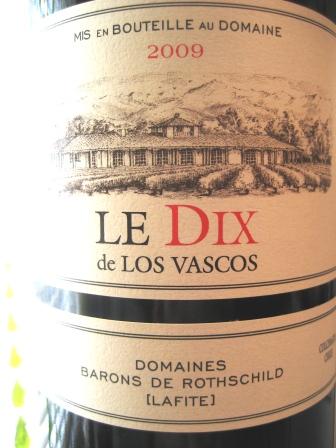
2009 Le Dix de Los Vascos cabernet sauvignon. The Rothschilds are making wine in Chile. (Someday, we really must learn more about the famed family.) If ever you encounter simply "Los Vascos" cabernet, do snap it up. It should retail for only about $10.


2010 Marques de Casa Concha chardonnay. I know people who won't drink Chilean wine because "it gives them a headache." Just Chilean wine. I ask you.


Below, beginning with Mormoreto, we resume our notice of "global reds."  This one is Italian.


The next, Argentinian. In my handmade signs in the aisle, I also cleverly underlined the 'm' in malbec to match the 'M' in Mendoza. Do you think people will notice?


2008 Raimat tempranillo. Spanish. 
"What?" my friend said. 
"You know," I started to explain. "Spanish. From Spain." 
"I KNOW," he said.


2009 Mazzoni Toscana rosso, Italian. Note that, as with Raimat, the vintage date of some three or four years back indicates that the wine has been aged a bit before release. In Mazzoni's case, you will pay a bit for the quality: It retails for about $20. 


Pinot noirs don't quite fit in to the "global red" category, because their acidity and slight gamy or earthy flavors are the opposite of the global red's dark, fruity lushness and almost sugary texture. But we include one, below, because sometimes they do come close. Parker Station retails for about $10.


Remember, also, our category of wines that are Perfectly Fine? Here are two more, both Italian. If you come across them, chances are your friendly retailer is trying to "blow them out" for about $5 each. He got a deal.

Villa San Zeno chardonnay and, next, Toscana (sangiovese and syrah blend). Perfectly fine.


Let's finish with something sparkling, shall we? Domaine Chandon Etoile rosé.  French winemakers come to Napa valley, set up shop circa 1983, and end up producing lovely things.


Escape hatch

Pardon a repeat of Feb. 2019, won't you? Warning! I've recently found out Blogger might be about to go the way of the dinosaurs. Sp...