Sunday, October 4, 2015

Twenty English words: starting with pink


It may have been some novelist -- or it may have been me -- who said during a moment of self awareness 'he had only ever really been interested in two things, the English language and, at a distance, people.'

The part about the English language certainly applies. Remember when we discovered truth trees, and wondered about the etymology of those two words -- remember we imagined the day and the scene when the words might have taken on their meanings, when some Oog the caveman thumped a tree and made some pronouncement that he said was as firm as this? When languages develop, surely some one person, Oog perhaps or some modern engineer, has to be the first to speak a particular sound to mean a particular thing. And it sticks. "Sky." "Email." Like Adam naming the animals.

The etymologies of very basic words have always intrigued me too, ever since I learned how often it's the vital simple words, so alike in modern languages, that are traceable to an Indo-European root, or sometimes two or three weirdly corresponding roots. Like truth and tree. (It seems one must nod here to Sir William Jones, 18th century philologist, who suggested the existence of Indo European, this lost ancestral tongue.) Mother, father, cow, heart, winter (from the same base as water, or to make wet), wolf. All the numbers, one through ten. It's pleasant to think that, once upon a time, our ancestors lived together long enough, somewhere in the Caspian grasslands, for Oog's decisions on words like these to stick. Then we split up, and we became Goths or Hittites or whatever, and began calling less vital, primeval things by culture-specific names. Glass, painting, butter dish. Like the Tower of Babel.

Anyway when you look up any word, a dictionary which includes etymology will cram into the space between the parentheses all sorts of abbreviations. They work backwards in time. They go from OE, say (Old English), to G (Gothic) to OHG (Old High Germanic) to L (Latin) to Gr. (Greek) and often to IE (guess), sprinkling in also the symbol <. It means "derived from." Sometimes it's <?. That's intriguing, too. How can a word be used and spoken despite its basics being utterly unknown? Once only I happened to find a word of no derivation and having "no cognates in any other language." I presume others exist, but this one happened to be toad. Old English, all the way. It only ever meant toad.

So I thought I would devise a new project, called Twenty English Words. Let's look them up. These are the first twenty that came to mind, either randomly or because I thought they might prove simple enough to have deeps and cataracts in their background. Or possibly I was hungry.

pink                                                            book
butter                                                          bread
rice                                                             water
milk                                                            cat
lemon                                                          chair
garlic                                                          lamp
cream                                                         daughter
thyme                                                         son
cup                                                             moon
peach                                                           sky

First on the list for research is 'pink.' I look it up, and what do I learn?

[<?]

No origin, no derivation, no etymology. Of course the word has definitions. It is a flower of the carnation family, a "pale red" color, it's a verb meaning to cut a cloth with a jagged scissors (a pinking shears) so that the hem will not unravel, and more. But why does the sound pink mean all these things, and why does no one know why? For heaven's sake, we seem to know shoe and sky are related ("a covering"), as are mouse and muscle (<L. musculus, little mouse, "from the fancied resemblance between the movements of a mouse and a muscle," and I am not making that up). But pink is a [<?] mystery.

When my Webster's fails me I turn to the great hero of lovers of English words, outranking even the good Sir William Jones by far I should think, and that is Samuel Johnson. It is amazing how in his Dictionary he can still fill in gaps. And he supports every definition with usage in literature; even my abridged facsimile-presentation copy crams in the explanatory annotation "-Shakespeare" or "-Dryden" with every entry. The full, original edition (1755), which scholars in BBC films are permitted to look at but not touch, includes appropriate lines from this play or poem or that. By contrast when modern dictionaries tell us shoe and sky both have to do with "a covering," we must take them at their word.

Here is Johnson's (abridged) pink.
PINK, n.s [pink, Dutch]. A small fragrant flower of the gilliflower kind. Bacon. An eye; commonly a small eye; as, pink-eyed. Shakesp. Any thing supremely excellent. Ibid. A colour used by painters. Dryden. [Pinche, Danish; pinque, Fr.] A kind of heavy, narrow-sterned ship; hence the sea-term pink-sterned. Shakespeare. A fish -- the minnow. Ainsworth.

The full dictionary entry, to be found online here and what a very honorable project it was of one Brandi Besalke to scan the two original volumes in their entirety and put them there, carries on. We learn it's in Romeo and Juliet that Johnson found pink to mean 'supremely excellent' -- "I am the very pink of courtesy" -- though Johnson allows "I know not whether from the flower or the eye, or a corruption of pinacle."

I know not, either. What a nice coincidence that we also recently embarked on our project of a line of Shakespeare a day, because affectation is fun. In thumbing through the Bard, we are doing a little of what the Great Cham (Johnson) did. The BBC scholars tell us that he did not think of a word, and then painstakingly consult literature to descry usage; he browsed literature, found usage, and then assembled the word list.


"...Commanded by such poor passion as the maid that milks." Antony and Cleopatra, IV, xv.


Tuesday, September 22, 2015

"Not fizzy enough"


Late in the workday.

Customer return.

"Not fizzy enough."

What do you think of this? 

We pour a little into a plastic cup. I sniff.

Wow. Biscuits and almonds, and toast. Fizz up your nose.

I sip. Bubbly, satiny, golden. Fruit metaphors pale to uselessness. The fruit of the tree of the garden of Eden, perhaps.

My, that's good. What are people thinking?

They don't know what they're buying. We'll see if we can get this capped up and you can take it home. Try to get a replacement for it.

Okay then. And thank you.

When I get it home I peer into the dark bottle with the oddly thin neck and realize it's half full. So the complaining customer sampled quite a bit before deciding it wouldn't do.

I take out a champagne flute, peer at that to make sure it's clean, and pour in Gosset Brut Grande Reserve. Nose in the glass, sip-and-savor routine. Think. Assess. But it's so enjoyable it seems beyond mere description. You just have to close your eyes in bliss and laugh. Doesn't matter that no one's watching. Wouldn't matter if anyone was.

Research: Gosset. Oldest Champagne house of all, founded in Ay in 1584. (Now the French were not Tudors, but the Tudor history geek in all of us rises up with a yelp at that year. Wow! Four years before Armada. Queen Elizabeth was fifty-one. Shakespeare was twenty. And so on. The French Renaissance, same time, was an entirely different matter. There's a gaminess to it. Wine goblets carved with erotic scenes at the bottom, so that maids-of-honors' reactions could be judged as they drained the cup at banquets -- younger royal sons raised as girls so they wouldn't be a threat to the heir -- the St. Bartholomew's Day massacre. And so on.) Chardonnay, pinot noir, pinot meunier. No malolactic fermentation permitted, which means the tart malic (green apple-ish) acids in the grapes do not transmute into softer lactic (milk-like) acids. Which means, if you think you taste creaminess, you are likely mistaken, or need to work on your rhetoric, or both. I've seen "baroque" offered up for Gosset, but what does that mean? Solitary blissful laughter, and gold bubbles?

Retail, about $70. Maybe it means that.

Psst. One tiny, tiny thing. It did kind of go flat in the glass pretty quickly. Like, in ten minutes. Is that secretly a sign of legendary quality?

Monday, September 21, 2015

Wine as psychological fun

I had the pleasure of attending a professional wine tasting earlier this week, and again I remembered Esteemed Colleague's words at Ye Olde Wine Shoppe, ever so long ago. He's the one who had already logged thirty plus years in the industry, retail, wholesale, and crush level, -- the man who had tasted Chateau Petrus before only big-game-hunting orthodontists could afford it, the one who remembered a time before wine "certifications," almost before sommeliers even. He said:

"Folks. Please. It's just wine."

The world is awash in so much wine, it is so soundly made and it may be had so cheaply -- I say it may be had cheaply -- that, when we professionals sit down to "taste and see" as the hymn goes, I can't help noticing that the afternoon quickly becomes a fairly amusing psychological study. Even though we are happily tasting far more than good, sound-but-cheap bottles, there really is very little to be said about them once a half-dozen or so adjectives are used up. The wines will have tannin and acid, fruit and alcohol, and it is salutary to be able to recognize all these. It's nice also to be able to recognize that climate and soil both matter: cool growing areas generally make lighter wines and hot climates make plusher ones, and grape vines prosper in difficult, rocky soil. (Not forgetting something I only just learned from the interwebs: since ancient times, man has had to compel grapes to prosper in poor soil because he needed the good earth for food crops.) Beyond these earthy basics, one can only offer pleasure judgments or food experience references entirely one's own; speedily we use up words like grippy or apple-y or pretty or whatever. My new favorite snark is to say "there's nothing under the hood."

What's left is the psychological fun. There is only one's taste, mine or yours. I think that my perceptions of the wines on the list are exactly right, exactly reflecting what is chemically, physically in the bottle and what the winemaker would say he intended to put there if we had him by the short hairs. But, dear things, my [professional] fatheads -- are you as confident of your perceptions?

We tasted pairs of reds, from California and France.

Ca'Momi Napa cabernet 2012 and Fleur Haut Gaussens Bordeaux Superieur 2010

cedar box                                                                       soap/no scent
 acid!                                                                             much less sugary-spicy
currant jelly                                                                  much chalkier
 -- clove -- cake                                                             acidic 
purple                                            "Classic vintage: cool summer, less fruit, restrained" 
$18                                                                              $12
                                                  
                                                                  
Frog's Leap Rutherford Merlot 2012 and Chateau Pavie Maquin St. Emilion Grand Cru Classe

slightly green                                                         wood
slightly vanilla perfume                                         wood (aroma)
very soft --                                                              light bodied
slightly prickly --                                                   silky
juicy, not sugary                                                     chewy -- slightly
 light bodied -- a bit plain                                     a bit plain
 $37                                                                          $60


Sterling Napa Diamond Mountain Cabernet 2013 and Chateau Larose Trintauden Medoc 2009

warm                                                                                       fuller
chocolate berries                                                                    juicier
velvety                                                                                    dry dark fruit 
soft tannin                                                                              chewy 
light acid                                                                                         
$20                                                                                                 $20

Mayacamas Mount Veeder 2009            and               Alter Ego de Palmer Margaux 2010

olives                                                                               inky black
barnyard                                                                         cola!
cherry candy                                                                 chewy tannins
acid-prickly                                                                   fruit 
licorice, light tannin                                  *at $90, this reaches Ca'Momi's level  ($18!)
$80                                                                                      $90


Stag's Leap Wine Cellars Cask 23, 2012      and          Chateau Ducru Beaucaillou St. Julien 2011

burnt toast                                                                              gentle cola 
thick tannin                                                                            elegant 
deep deep baked fruit                                                            gentle tannin 
pie crust                                                                                gentle acid
$200                                                                                      $130                                                                                 

Note how the California column boasts more vivid descriptors, and more of them, than the French column. I'm sure I'm right about it all, but I suspect my [professional] fathead/colleagues lack confidence in their ideas, because the silence, the abashed looks, and the hurried yet limp agreement as soon as anyone says anything about the red liquid in the glass, is all so obvious. Everyone still, still -- and I noticed this even at Ye Olde Wine Shoppe, ever so long ago -- everyone wants to be perceived as having innate, classy, yet malleable and un-snobby taste. We can spot a stereotype, delightfully untrue to form; we can spot a stereotypical disappointment, this time delightfully good. We want to recognize the king instantly and yet be respectful of the peasant. But who knows whether one can?

I suppose all this explains why there are blind tastings. It's informative to eliminate at least one trigger of prejudice or anxiety -- namely, the identity of the wine -- from what should be a simple evaluative process. Better yet, a parlor game.

Of course when it comes to speaking up confidently, I'm as big a fathead as anyone. Scribble my notes and arrange them in columns as freely as I may, do you think I told a soul that "it took a $90 Bordeaux to reach the quality level of an $18 Napa cabernet?" Certainly not. What if I'm wrong? Do you think I told a soul that the two paired merlots, each first class and each bearing a hefty price tag, struck me as interchangeably dull? Certainly, no. Did I throw in a mention of Michael Broadbent and his "global red"? No. And as for the next-to-last sample of the day, the legendary Stag's Leap Cask 23, do you think I raised hell at the pronouncement that "this isn't at all the jammy California fruit bomb we'd expect, is it"? Of course it was, I wanted to raise hell. More than a fruit bomb, it was a Hostess frosted-fruit-pie bomb. I'll bet its residual sugars stand at Apothic Red levels, and I would pair it with no food at all. Too overwhelming. This is a cocktail, and a safe, legendary label to tuck beneath the Christmas tree for your orthodontist father-in-law who Knows a Lot About Wine.

There. "Folks. Please ...." I didn't say that either. But I'm sure I'm right.


Image from foros.vogue.es

Sunday, September 13, 2015

"Pfui."


When fictional detective Nero Wolfe offers an opinion without research or consultation, he introduces it with "Pfui." 

It is remarkable how little commemoration September 11th gets. Ordinary people wear patriotic t- shirts or fly flags from their pick-up trucks. A local car dealership conversely put its flag at half mast. But true commemoration, communal and natural, can still only really come from united journalists. If nothing else, they would announce masses and rallies and they would report on them. If there were no masses and rallies and they wanted them, they would create them. And they won't do it, I think, because at some very deep level they cannot believe that they, too, were targeted when New York was targeted. For God's sake -- their heart of hearts protests -- they report on the rubes and hayseeds; they aren't them. I think this also explains why journalists offered up to the world as soon as they could, adored and unvetted and as an act of atonement, an essentially Muslim president. No! No! Not us. Look -- here! We'll make it happen. Look how beautiful he is! 

All this is not to deny our own responsibility for events and reactions and votes. But future historians will look back and see these two things standing out. That's all.  


Tuesday, September 8, 2015

Vouvray


2014 Bernard Fouquet Domaine des Aubuisières Vouvray, Les Girardières. A Vouvray is a delectable, somewhat odd little wine. If sweet, it is sweet and full-bodied without the juicy, fragrant fresh-grape "crunch" of a good moscato. If dry, like our recent Champalou, it will have the mouthfeel of fresh peaches but a peculiar funk that seems to bring us up short and make us look at the label and exclaim, Oh I see. A dry Vouvray ....

We're still pursuing our Shakespearean affectation.

Let the birds fly, and like the famous ape,
To try conclusions, in the basket creep ....  (Hamlet, III, iv)

I love when editors' notes on Shakespeare are no help at all. For these strange lines, we learn only that the "famous" ape-in-the-basket story is no longer known.

Sunday, September 6, 2015

Very small matters, quickly

Very minor points, but they struck me:
  • a woman judge shows up in the courtroom scenes of an old episode of Perry Mason, which I watched late one night for the fabulous '50s clothes and makeup; who knew that such a thing could occur prior to our own enlightened era? 
  • consider new meaning in the phrase "to have a pair." Nowadays it refers to testicles and courage, and is only vulgar. In the Nero Wolfe mystery Too Many Clients, Rex Stout uses it in an entirely different context. Wolfe's factotum (I guess) Archie Goodwin says to a helpful acquaintance, " 'Come off it. You haven't even got a pair.' " Any young person reading this today would probably laugh happily at such a startling modernism, but also miss the point. In 1956 it was a poker reference, wasn't it? And it meant "you haven't even got [so lousy a hand as] a pair [of any two cards]." 
  • and, Archie's meals so far sound delightful, as cooked by Wolfe's chef, Fritz. Wolfe also employs an orchid valet, but more on that at another time. Chapter 3 opens with this:
"There was a bowl of chestnut soup, a cucumber-and-shrimp sandwich on toast, a roast-beef sandwich on a hard roll, home-baked, a pile of watercress, an apple baked in white wine, and a glass of milk."
I take it Archie's glass of milk is going to be a running gag throughout Rex Stout's series.

Finally, your Shakespeare quote for the day. We'll pick at random as usual. Perhaps it will, coincidentally, have to do with mystery or crime? People say everything is in Shakespeare.

Oddly, it might --

King Pandion, he is dead
All thy friends are lapped in lead

-- but it's from The Passionate Pilgrim, grouped in "Poems of Doubtful Authenticity."


Wednesday, September 2, 2015

A line of Shakespeare a day (because affectation is fun)

Falseness cannot come from thee, for thou lookest 
Modest as Justice ....

Pericles, V, i.

I have a chalkboard/bulletin board/message center on my living room wall, and so I decided to use the chalkboard to write down a line of Shakespeare a day. I flip open my big 
Complete Works and take whatever my eye falls upon. No reason, except chalkboards are fun and I don't have anyone around to explain myself to. Although I must say, I erase it before company visits. No point in explaining myself.

Maybe it's not entirely affectation. I end up reading one more line of Shakespeare, per day, than I would do otherwise. 

The wine is 2014 Field Recordings Hinterland Vineyard cabernet franc. Very good -- juicy and bright, lush without being sugary. Retail, about $18.

Tuesday, August 25, 2015

The one-time, irreproducible, crazy-local gourmet recipe: or, I can do that


Make no mistake. I like food magazines. But sometimes they are annoying. For every simple recipe for something good, like say "Apricot Clafoutis" (which sounds mysterious but is essentially pancake batter baked in a pie dish and topped with fresh apricots -- Food and Wine, August 2015) they provide six more which look stupendous in color photographs but which the average cook won't reproduce because she is not inclined to rush out to that organic textile/non-GMO bison farm in upstate New York -- or outside Portland or Seattle or Nashville -- where that up-and-coming Manhattan chef spends his summers getting away from it all and thinking up new "small plates" sourced from his twenty-acre experimental locovore garden. I'm talking about, but will likely never make, recipes like Cherry and spring onion salad with Asian fish sauce, Peach, burrata, and pickled pepper salad, Red cabbage and fried Mortadella Okonomiyaki, Ajo bianco with crab and green grapes. We're getting into the July issue here.

We're also talking about a fussy complaint that the editors of Food and Wine could shoot down in a jiffy. If the magazine annoys you, they would say, 1. don't read it, 2. recognize that it's meant for entertainment, and that's why we have test kitchens, 3. recognize that novelty and creativity drive the restaurant business, 4. recognize that this level of novelty and creativity eventually drives new products down to the supermarket level, which is where you shop for foccaccia and Brie, dear (it's the famous "blue sweater scene" from The Devil Wears Prada all over again), 5. recognize that only a day's -- only an hour's experience transforms an ingredient or a technique from something you consider crazy-progressive-stuffed shirt into something you know and like, a la clafoutis; and 6. then go buy Woman's Day. Rock those hamburger casseroles.   

But you see the reason I bring up the fussy complaint at all is because I think recently, on a small scale, I cracked the code. I did what the chefs and the food writers do: assemble an unusual, irreproducible food or drink item from a handful of ingredients that I happened to buy all at once but that few other souls are going to have ready in their homes. Voila: food as literary and artistic entertainment. The up and coming chef.

Up and coming mixologist, rather. What I bought all at once, and on vacation at local shops, were just sweet, orange-fleshed "Simka" Japanese plums and a small bottle of Spice & Tea Merchant's Blood Orange pepper. What I had ready at home, as who doesn't, were rum, lemons, and sugar. The professionals who relax on the farm by tossing cherry, onion, and fish sauce salads may laugh at my clumsy dumping together of all this... stuff. But I made a new type of Rum Sour.

Simka plum and blood orange pepper rum sour

1 to 2 Simka plums, peeled and sliced in halves
good pinch Spice & Tea Merchants Blood Orange pepper
1/4 teaspoon sugar
juice of one lemon
1 jigger (3 Tbsp.) rum

Muddle one of the plums in the bottom of a rocks glass. In a cocktail shaker, combine sugar, lemon juice, rum, and pepper. Add ice and shake gently to mix. (Too much shaking anesthetizes flavor, which is why, contrary to James Bond's instructions, you do want to shake and anesthetize the flavorless but powerfully alcoholic vodka martini.) Strain into the rocks glass, garnish with a toothpick stuck with the other peeled plum halves rolled lightly in more pepper.

Incidentally the Spice & Tea Merchants' store reminded me a bit of the WineStyles store where I got my start in the wine industry. It's another franchise, each shop meant to look like a local entrepreneur's idea, each shop laid out the same way -- dark and rustic in this case -- and stocked with the same products. The franchise fee to join and get started on the path to opening your own store is $17,500. My question is, who would imagine that demand for these particular spices and teas is such that a store like this can stay in business more than a few months, anywhere, tourist mecca or not? There was small enough demand for the wine, all those years ago, and chances are if you bother buying a bottle of wine, you will use that up faster than you will use a jar of blood orange pepper. Quaint and interesting, to be sure, but next time I'm on vacation if the store is still there I'll buy something different. There must have been a thousand quaint products on the dark, rustic shelves. They've been open a year. The matter in my jar was solidified, to be fair perhaps because, according to the ingredient list, so much of the "pepper" is sugar. Still. I was the only customer in the store. I wonder when was the last time they needed to place an order for re-supply?

And -- startling thought -- could lack of demand and irreproducible, crazy-local recipes have something to do with the fact that so many of the chefs and mixologists in Food & Wine seem to bounce around so from one awesome gig to another? They are all young and happy and at one with the land, but have resumes as long as rap sheets.   

Saturday, August 22, 2015

Behind stars


This is the view out the cottage door.


These are bluegills, under the pier. I tried for an artistic shot by just aiming at the water -- I tried for a lot of artistic shots, by just aiming at the water -- and what do you know.


This is the view over your head, when you are relaxing on the lawn chair in the afternoon. You've seen blue sky and trees before, but I like to capture exact things. Perhaps it's the historian in me.


Sometimes there were clouds. Magnificent ones. Morning or evening, didn't matter.


I walked around the lake. I met a handsome rooster. I swam.


I took selfies. Tried to be artistic there, too. The young fashion bloggers would have "rocked" something other than a tank top, I suppose.


Away across the lake is an elegant property that always reminds me of some shimmering, time-warp affair from the eighteenth century. The white house, secluded in the trees. The gazebo, never used. The gentle watery jungle at the shore. Swans.


I imagine ladies in long sacque gowns (the Augustans never thought of anything so vulgar as a hoop skirt) trailing down to take tea or maybe champagne in the gazebo, accompanied by gentlemen in breeches and striped waistcoats. No powder in the country, surely. They would find everything "extreamly pleasing."


I bought an eighteenth-century lady's diary at the secondhand bookstore in town. She was Elizabeth, Duchess of Northumberland, 1716-1776, and her Diaries, or a redaction of them, were published by George H. Doran Co. in 1926. Only in the vigorous 1700s, it seems, will you find ladies recording bluntly, Went home voided a large Stone. Tired to Death. Went to Ball; tired to Death. A bad supper. Miss Townsend drunk. Or, having such interesting evenings as this:

We returned home & after Dinner, Ly. M. gave an Acct of her Husbands brutal usage of her -- beating, pinching, & kicking her; having an intrigue with her sister, who offered to put Ly. Mary out of the way if he would go to live with her abroad.   
It makes one, as the Duchess might say, entirely asham'd of one's own Reflections, which seem to go on for years all about Struggling with one's Feelings, &c., &c., and are dull and mewling in comparison. To be fair -- to myself -- the eighteenth century provided any diarist with experiences and sights which make effortlessly vivid reading now, but which they probably would have been glad to be spared. One day in November 1765 her Grace saw an opera singer perform, a woman named Spagnoletti. Imagine this:
The Spagnoletti was as ugly as the Devil, half her Face being burnt away she supplys it by Pasteboard, has a Glass Eye, dresses like a Gorgon and is as hoarse as a Raven.
Wellllokaythen, as we mewlers say today.


For five days I was unplugged from the world of news and wise men's commentary. I came back to stories of the kind of evil, taking place in our own country, that we used to shudder at and call satanic when our and our allies' troops uncovered it in the enemy's liberated concentration camps two generations ago. Who is the "technician" who cut a baby's face open with scissors to extract his brain for research? Why isn't he -- or God help us, she -- on trial for crimes against humanity? Yes, to mention this is jarring amid the water lilies, but the testimony exists. No eighteenth century person, duchess or otherwise and vigorously aware of right and wrong, would have ignored it. I dare say if any one of them could step forward from their gazebo on the water, the first thing they would do is slap all of us full in the face. And it wouldn't be a silly gesture.


I went out at night to see the stars in a truly rural environment, and was rewarded with a view of the Big Dipper that I never get from my suburban balcony. Of course there were many more stars and constellations I don't know; it can be really freakish to look up long and patiently and begin to see a three dimensional picture, to see distance in space: fainter stars behind faint stars behind stars. I stayed out long enough to accustom my eyes to the darkness, and discerned the Milky Way. Our galaxy, edge on. Imagine being able to see the spiral. Are there wondrous planets where that fills the night sky? Ignorance in the age of the iPod queries also: does the Milky Way always stretch, for us, in the same direction across the same quadrant of the heavens? Does it always appear as I saw it, thickest overhead and tapering off a little to the east of the North Star? (Which I only spotted because in grade school we still were taught that the stars in the bowl of the Big Dipper point to it.) Or can it "move"?

Later, I ventured out in the very small hours, 3 a.m. in the wilderness, because when am I ever in the wilderness? -- and had the satisfaction of seeing, in the oddly not black but sepia-gray night, that the Big Dipper had gone from its place in the southwestern corner of the rim of trees around the lake. A sort of triangular collection of bright stars had moved from above the eastern treeline to the nighttime zenith. Then a creature, a heron I think, squawked closeby with that scratchy sound like a giant door creaking open. I thought I must have disturbed the bird's nighttime fishing, and I crept back inside. But I witnessed: so it's true. Stars and things do vanish from east to west as the earth turns on its axis. Perhaps that, or some character's ignorance of that, could play a part in my Michigan mystery novel. At the bookstore along with the Duchess' diaries I bought Whitney's Star Finder (Knopf, 1989), by Charles A. Whitney, "Revised, Updated, and Expanded for 1990 through 1995."


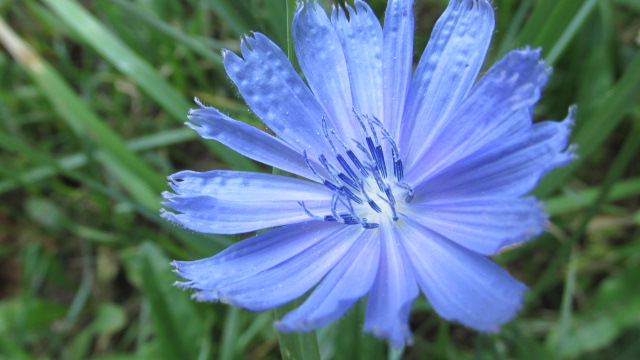
And there are a hundred other things. What are the aquatic plants that grow in freshwater Midwestern lakes, what are all the roadside flowers  -- above is chicory, we think -- that surround them, what are the fish in them? What are the bugs making that clacking sound all night, like the teeth of a cogged wheel turning and scraping rhythmically against something? Somehow one thinks the Duchess of Northumberland would have known most of this. Especially about the stars, maybe. 

Wednesday, August 12, 2015

Are you?


Are you a diary-keeper? O gad. Have you ever gone back and read them? 


O gad. I can tell you a few things. You were a nicely righteous preteen. "Why didn't God give Hitler a heart attack?" Then, you learned the words bitch and fool, and everybody was one. But you also snapped, and pasted in physical pictures of, your backyard. They have endured and kept their color, folded into a dime store notebook for thirty-five years.


You copied out song lyrics, such that, even now, looking over what seems a bizarre obscure poem will quickly put a long-forgotten melody and a voice and even backing orchestrations right back into your head. Like so.

There's a house
On a hill
By a worn down weather'd old mill
In the valley below where the river winds
There's no such thing as bad times
And a soft
Southern flame
Oh Cotton Jenny's her name
She wakes me up when the sun goes down
And the wheels of love go 'round,
Wheels of love go 'round

Later on things got a bit more serious. You gushed gaily in simple French -- et pourquoi? -- when you were in love with your much-too-older community college professor. Of course he hated Ronald Reagan, and liked to refer to the president and his wife as "Ronnie and the Empress Dowager." Such an original mind. Later, you wrote anguishedly in worse French when you didn't want posterity to suspect you had any doubts about true love, or where it lived. You had to consult your high school French dictionary to understand how to write je suis tres, tres, fachee. But, later again, "I'm almost sure I'm pregnant" came in plain English. This was back when home pregnancy test kits were not yet totally reliable.

What's most curious is that, having via all this scribbling purged from your mind whatever you wanted to say about bitches, fools, love, professors or song lyrics, -- when you chance to re-read it, what you chance upon seems to get branded into your mind for good. From time to time you may have had the idea of "going over your old diaries," typing them up for history's sake and for safekeeping. But it's just this fear of what you'll re-find that stops you.

So you might buy an old cedar chest, and put them all in there. You even toss in an old passport, your only one ever. That's what cedar chests are for.


Monday, August 3, 2015

The August moon

The miserable Lucia started a run of extreme bad luck about this time, of which the adventure or misadventure of the Guru seemed to be the prelude, or perhaps the news of her want of recognition of the August moon, which Georgie had so carefully saluted, may have arrived at that satellite by October. For she had simply 'cut' the August moon ....
E.F. Benson, Queen Lucia (1920) 

Strange bits of old knowledge always fascinate, don't they? Writing in 1920, E.F. Benson was still familiar with some sort of folklorish custom in which one "saluted" the August moon. No moon phase is specified, whether new or half or full; no one is saluting the January moon or the harvest moon. August, only. Failure to do so brings bad luck.

I don't know if July's second full moon, the blue moon, counts as part of August's too. Certainly it seemed rude, in a cosmic sense, not to sit out on the patio with a glass of wine and a plate of cheese, and admire "that satellite" as it rose, a gleaming mother-of-pearl gold against pale daylight blue sky, and then turned its usual, sophisticate's brilliant white-on-black. "Like a jewel hung in ghastly night," as Shakespeare said (Sonnet 27). You have seen better pictures of it, but far be it from me to "cut" it in any way.


The wine was 2013 Selbach-Oster (the producer) Zeltinger (the town) Himmelreich (the vineyard) riesling (the grape) kabinett (the harvest designation -- first time through the vineyard, to be followed, if the winemaker thought it wise, by 'spatlese' and 'auslese') halbtrocken ("half-dry"). It all means that a riesling's mild, kabinett sweetness was cut not only by the grape's natural acidity but also by a kind of firm, stony core. It's when wines have this that you enjoy drinking something more interesting than grape juice.


One final thought: I was all set, today, to go on a righteous rant about the Traveler Beer Company's beer, "The Illusive Traveler." I thought, for heaven's sake, modern craft beer is far, far too much in the hands of ignorant young men who still think, for example, that the raised-fist "Revolution" theme is cool (umm, hint: you won --  your glorious President is now going to outlaw coal -- "revolution" now means dissent against you), and who don't know grammar. "Illusive" Traveler? Dear things -- my fatheads -- do you mean elusive -- to elude, to be hard to find? Do you mean a traveler who isn't there, hence illusionary? Do you mean a traveler whose courage and adventurousness are to be copied, and is therefore illustrative?

Here is what Traveler Beer's marketing department says:

Driven by an unquenchable thirst for discovery, the Illusive Traveler often disappears for weeks at a time without telling a soul of his destinations. Not friends. Not family. No one. And each time he returns, he unveils new, wonderfully refreshing beers with great aplomb.
When pressed to reveal his travels, I.T. changes the subject or dodges the question by refilling the inquisitor’s pint glass with his latest recipe ....

I was fully ready to believe that a major company had created a product and done all the marketing and gotten the product on the shelves, all the while a glaring, end-of-civilizational error had escaped everybody's (that is, all the young men's) notice. But -- in fairness to myself, as Georgie would say -- and in fairness to all, I did my research first. Perhaps my salute of the moon protected me, or perhaps I was just well-trained by seventh-grade English composition teachers.

I opened the dictionary. It turns out there is such a word as "illusive," Adj.: illusory, unreal.

There. No rant. When I am wrong, I own it, as Lucia very nobly would say. This doesn't mean civilization isn't ending, for one wonders how it can exist without coal, or with a glorious President who loathes the thing itself. But at any rate we know that the young men in beer marketing departments still use dictionaries. I can't believe they knew the word for its own sake.

Escape hatch

Pardon a repeat of Feb. 2019, won't you? Warning! I've recently found out Blogger might be about to go the way of the dinosaurs. Sp...