Wednesday, December 9, 2015

Aaand good morning to you

From the corner of my eye I noticed a fluffy, shadowy thing in the tree outside, a thing which seemed fluffier and darker than any usual bird.


Stay right there, young man, I thought. I'll get my camera.


I assumed there was no way he would stay.


He did. He had brought his breakfast.


Time to relax afterward. He is, I think, a red tailed hawk. Juvenile, perhaps, with all the spots on his chest? Female? Or a sharp-shinned hawk? Or even a Cooper's? "Experts have a hard time telling these last two apart," the bird guide says. "Best to just write down 'accipiter species' in your notebook." Okay.

Whatever he was, the sparrows certainly understood when it was safe to come back. 


Tuesday, December 8, 2015

Ritme, rhythm, juxtaposed things


Brief notes:  70 % carinyena (carignan), 30% garnaxta (garnacha); brightly fruity with a dense but still plush core. From the Priorat region of northeast Spain, an area known for fine red wines particularly since the 1990s. Very delicious. Retail, about $25. 

Ritme means rhythm. The [English] word always reminds me of the time my school friend Nancy got herself out of a sixth-grade spelling bee by deliberately misspelling "rhythm." She glanced nervously at our other little school friend Kara, who had just done the same thing with some other word. They sat down together in the audience, flushed and finished. By age 13, they were too cool for spelling bees. I stayed in ....

So we think of rhythm, of mismatched things going together in a pleasing way. I know rhythm has a technical musical definition but I could never understand what it was, nor how it differed from beat. Those were the only two questions I got wrong on tests in a college Music Appreciation class. I was fine with specifics on the names of medieval musical notes, on the other hand.

Anyway rhythm in the sense of mismatched things going together in a pleasing way -- note the art on the label, above -- makes me think of a movie I watched again recently, a favorite. Do you remember Sofia Coppola's Marie Antoinette (2006)? I gather the French press at Cannes hated it at the time, and I don't recall it being a box-office smash, but I have always liked it. For one thing, the photography is gorgeous, beginning with the scenes of a carriage journey through sumptuous gray-mist and amber-brown woods, just touched with red leaves and green moss on the trees, and going on to Versailles, which, to be sure, it would be difficult to make look bad. I especially like the occasional long overhead camera shots of one or two women in their gowns ascending immense staircases on the palace grounds. I don't suppose many people have had reason to climb those stairs in those clothes since the events in question, unless it were to make movies about them. So shots like that seem to me a snippet, almost, of time travel. Figures in a landscape. Here is how tiny they would have looked.

Once at Versailles, the film's juxtaposition of an eighteenth-century story with modern pop music and all those "jump cut" scenes of shoes and candy, again, gorgeous, might seem artistically a cacophony and a disaster. Not rhythmic. Add the hiring of healthy, toothy young American and Anglo actors and actresses to play characters whose minds we cannot possibly reconstruct -- and the mind shows through in the body, in posture and gestures, don't you think? -- and you have awkward scenes. Young modern men dressed in tricornered hats and breeches goof around in the woods. Young women in gowns and fichus apparently ad-lib their admiration of the chickens at the Petit Trianon's little fake farm, the "Hameau." The cameras follow them.

But I think these are exactly the things Ms. Coppola got oddly right. Those characters did wear those clothes in the woods in 1770. Duchesses invited to the Hameau may have had to enthuse weakly over the livestock. Overall I think she got right the understanding that here were some bored young people, living a life beyond mere wealth, who had very little to do all day. They followed palace etiquette, they milled around. The young men hunted. There were clothes and food. There was gambling. After forty-five minutes or so of this, plus shoes and candy, to be sure the movie-goer wants to say "all right, step up the pace, let's have something happen." But this is what their lives were like ... the slow passage of days and amusements, like pictures in a book. Eight years to consummate a marriage would seem an eternity.

The languid pace makes the final scenes, of disaster, also emotionally sensible because they come on as nearly inexplicably and violently as they must have done in real life. When we see the king and queen eat dinner in public as usual, but in a strangely dark room, we know something horrible has changed. The roar of the angry crowd penetrates from outside. Later, on her balcony, Marie Antoinette bows to the thousands in her courtyard, nothing heard but the thrum of the wind blowing the flames of the torches. The people's farm tools look beyond wicked. In bright silent daylight the next day, we see the shattered gorgeous bedroom.

The movie's real weaknesses may stem from Sofia Coppola's director's hand being languid and light in every respect. Not only do the performers seem often at a loss, but the IMDb movie site lists dozens of continuity and historical flaws in Marie Antoinette. Does that point to sheer laziness? Is that what the French at Cannes resented? The gorgeous carriage ride must be flaw number one. The woods look autumnal, but Madame la dauphine made her journey in May. Then there are the jet contrails above the palace. I never noticed. It might be a glancing, forgivable error except the camera was pointed deliberately up for that scene. I noticed later. Why didn't the cameraman see? Or the director? Four-tined forks and Pekingese dogs were both unknown in that era, IMDb also tells us, although that seems farfetched. Perhaps some diary or bill of sale will be unearthed someday, to attest that they were. On my first viewing of the gorgeousness I was more distracted by sheerly ignorant things. His Majesty's calling out "bravo" to his wife after a performance at her theater, for example. Her Majesty's inability to handle a tea cup and saucer.

Talking of distractions and flaws, maybe it's no one's fault but is simply today's beautiful, sophisticated cameras that are part of the trouble when it comes to telling a story set convincingly in the past. Hollywood no longer films period-piece stage plays, whose sets and costumes are already part of the creative structure and so help us along in suspending our disbelief. Recently I watched on YouTube Bernard Shaw's Caesar and Cleopatra, starring those two legends, Claude Rains and Vivien Leigh. Act One's rocky escarpment, Sphinx, and moonlight looked perfectly ridiculous, but they were at least professionally undistracting. This was theater. "We are in ancient Egypt." The beautiful modern camera, not focused on a stage but recording actors acting on a spot in our own world, records everything so perfectly that you cannot help seeing that is today's sunshine, lighting the silver-blonde curls of the little French girl playing Madame Royale, the queen's daughter. (I love French honorifics.) The tot is truly absorbed in "la petite abeille," the little bee, in the garden. And there are the jet contrails. Who was on that flight? Rip Torn, the actor, costumed, steps carefully over tree roots and underbrush to go and greet his new granddaughter-in-law, Kirsten Dunst/Marie Antoinette. If our Ms. Coppola ever ventures into stage work, I think she will have a hard time understanding the concept of the fourth wall.

In spite of all the foregoing, I find Marie Antoinette repays fresh viewings. If only for the sumptuous photography, perhaps. Juxtaposing it with Norma Shearer's Marie Antoinette (1938) can make the latter film seem actually heavyweight. Shearer and Robert Morley, as Louis, had emotions.

And I was wrong about rhythm meaning "mismatched things going together in a pleasing way." Maybe that is harmony? Rhythm means "a flow or movement characterized by recurring elements or features." From the Greek rhythmos, measure; base of rhein, to flow. "See STREAM."

Wednesday, December 2, 2015

Blogging the ... source of Western civilization?

All right. If the yelling pundits and scholars, activists and chin-pullers are correct and Western civilization is in free-fall collapse, attacked (pardon the mixed metaphor) on one side by its own exhausted moral relativism, its shoving away of Christianity and its guilt at what it did to itself and other people in the 20th century; and attacked on the other side by rampant and grinning and violent Islam, then -- all right -- what will we find if we return to the West's sources? Will we rediscover exactly what was so "civilizing" about it all? Can it be put to use again, in the individual's life? Was it really so attractive, so different, so wondrous?

Since we seem pressed for time and since I think it would be useful to grab on to what little of "the West" is at all present in a lot of people's lives, I decided to open the Gospels. No one but scholars are reading other Western things, ancient Greek plays or Roman law arguments, no one but the incredibly devout -- or orthodox Jews, probably -- are reading the more obscure books of the Bible, Isaiah or Psalms for example. No one but scholars are reading Enlightenment science or Voltaire. Also, Charles Murray in his great book Human Accomplishment credits Christianity for much of the West's roster of superb achievement: Christianity, he says, taught individual man that he is of infinite value, and that when he explores his rational and artistic questions, he honors the truth and beauty of creation, and therefore pleases God. (Judaism launched this, but then held group survival, understandably, higher than individual meandering you might call it and so, on the whole, produced less. Islam valued nothing of the kind, stressing only submission and the violent expansion of submission throughout all the world. The Eastern faiths also valued nothing of the kind, stressing mostly tranquility until the gift of death.) If Murray is right, then the Gospels are our fount.

In addition, a writer at Chronicles worries that our collapsing civilization is "coasting on the fumes of natural law." This sounds alarming. (It's amazing how you can read just one thing and find yourself blinking.) What is "natural law"? It is the idea not only that God created an orderly, comprehensible universe, but that man has "a nature and a moral purpose defined by" his creation, also intended by God. In other words, there is stuff we should be doing and thinking, or else we are wasting the gift of life. If you google "natural law" you quickly find the most prominent name mentioned about it, after Aristotle, seems to be St. Thomas Aquinas. His summary of it can be simple: "good is to be done, and evil avoided," always remembering our God-given nature and moral purpose. A lot of the pundits' yelling and chin-pulling seems also to translate to this, that coasting on the fumes of natural law means Westerners are still nice to each other, Western men are nice to women for example, in a way non-Westerners are not, -- but we no longer understand why. It's all fumes and no fuel. For us "doing good" has degenerated into tolerance and compassion for whatever. This now includes tolerance and compassion, for example, for Muslim men who are cruel to women. And yes, Islam rejects natural law.

So, in randomly reading essays that make me blink, in wondering about Western uniqueness and unearthing this large matter of natural law, the Christian roots of science, St. Thomas Aquinas, etc., -- it seems we must unearth, again, the fount of the Gospels. Since churches still stand and one-third of the American population are evangelical Christians no less (not to mention other types), I think I am justified in grabbing on to these four short books, Matthew, Mark, Luke, and  John, as constituting "what little of 'the West' is at all present in a lot of people's lives." If it is present there, how does it make them operate? And if it has vanished elsewhere but was once a good, can it be revived? It's like an anthropology experiment. Before you travel to the island to observe the tribe, you read the classically accepted fount of their folkways. You hope not to repeat Dr. Johnson's experience in the Hebrides: "We came too late to see what we expected."

I have done my share, my fatheads, of exploring religious folkways, but I haven't opened the Gospels in about twenty-five years. Thereat in approaching Matthew, who comes first, I will be in the position almost of an ignoramus.


Sunday, November 29, 2015

I've decided birdfeeding is like raising chickens, only


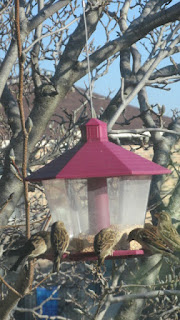
... only minus the trouble of health care (for the chickens), coop-building, and so forth. Unhappily, I have yet to attract anything more exotic than a cardinal and a black-capped chickadee to my patio. "Frequent visitor to winter feeders," the birdbooks say. In other words, big whoop. Besides, that is neither of those, above. That's another sparrow. One of many. 

Below is my Michigan chicken, whom I met on a walk around Lake Osterhaut and whom I have decided to virtually adopt. His name is going to be either the Kaiser, after my late grandfather's legendary backyard-Chicago rooster (we're talking circa 1930 -- chickens must run in the blood), or Champers. "Champers" is wine-professional slang for champagne. The word simply cries out to be a pet name. Since two cats are enough for the moment, and dogs are out of the question and indoor birds are a smelly mess, and small rodents have never appealed to me, Champers the virtual chicken it is. Isn't he handsome?
 

A great many chickens are very handsome. They are called "exotic," and are said to be, as a group -- Gallus gallus, even the Latin of their name is dignified -- the closest living relative to Tyrannosaurus rex. Sometimes I think scientists get excited and make things up, in fact we know for a fact they get excited and make things up, but anyway this idea is amusing and harmless.

If I want to give you a gallery of more virtual chickens, bearing all the great pet-names-from-the-wine-industry that I have not had a chance to use for real animals yet, Bourboulenc and Clairette and such, then I will have to hunt up Google Images or Pinterest and procure them like everyone else. I'm happy to credit any blog or site for photos, but does the procuring still create a "stolen bandwidth" problem? Or has technology solved all that? The only site I have ever known to trace me into the weeds and actually dismantle an image that I copied and credited was Project Gutenberg -- the very site that started out all about free access to out-of-copyright books. Ironic, no?

Below, -- oh, let's call them Bourboulenc and Clairette. From the blog Chicken Street.


Next: gorgeous, French; photo by Claudie Niery. We want to use the name "Picpoule," but that seems effeminate for this surely masculine creature. He is, I believe, le coq of France, so we will call him something proud and manly, Crusaderish even. Richard.


This next one seems to be pausing, on a beautiful spring day, on her walk from the coop to the library. We'll call her Scholastica. From the blog The Chicken Chick.


Back to reality. Winter, and the courtyard cardinal. Probably named Larry.


By the way, speaking of Crusades, I want you to read an excellent summary of them here, at a site callled ARMA, the Association for Renaissance Martial Arts. In "The Real History of the Crusades" Professor Thomas F. Madden argues that mature scholarship is beginning to acknowledge these wars were a near-desperate, centuries-long European Christian response to cascading Muslim jihad -- something we are beginning to be reacquainted with -- and that they were of course, on the battlefield, eventual failures. But he says: with the Renaissance and after,    
"The Muslim threat was neutralized economically. As Europe grew in wealth and power, the once awesome and sophisticated Turks [Islam's most important representatives then] began to seem backward and pathetic—no longer worth a Crusade. The 'Sick Man of Europe' limped along until the 20th century."
After which, I suppose, the Sick Man's co-religionists found oil under their sands, and then learned it gave them the money they needed to buy weapons and really resume jihad. And, broadly speaking, here we are. 

At any rate, I find it a piece of great hope to reflect that it may just be wealth, the peaceful arts, leisure, consumption, even frivolity -- exotic chicken raising, for heaven's sake -- that have served to turn back another, endlessly predatory civilization whose main attributes turn out to be impoverishment and suffering. (No wonder the left loves Islam. Nothing else impoverishes and equalizes like it, except their own Marx perhaps.) This is not to say battles and victory don't matter, of course they do. But how remarkable it will be if the very things our pundits bewail, in best end-of-civilization, Chicken Little style, things like yoots absorbed in video games or the activity that is Miley Cyrus, turn out to be powerful weapons themselves. Of course we want our yoots to know Shakespeare and Beethoven, too, which is a struggle and ideally should not be. I'd like Miley Cyrus to know Beethoven -- now there would be a clash of worlds. 

But the sheikhs and "extremists" have long feared our embarrassing, frivolous weapons. I'm glad. 


Friday, November 27, 2015

Three stories, three questions footnote

I don't know why Blogger changed the font on today's post, "Three stories, three questions," making it so large and clumsy, but I can assure you I don't like it any more than you do. 

Three stories; three questions

After reading a lot of scholarly reactions to the November 13, 2015 jihad attacks in Paris, one man's remarks struck me.

Daniel Pipes thinks that only casualties in the hundreds of thousands, or more, will ever prompt Western elites in government, in bureaucracies, in media, in universities, to acknowledge that jihad is Islam, and then to address that. It would cost them their modern, educated souls to climb down from 21st century multicultural understanding to a medieval sort of will-to-live, freely. Until then, he thinks, leadership moves leftward after every attack, mouthing gentle things about extremists perverting the religion of peace, so as not to upset the "secular order" which they control. They stay cool and objective, they interview CAIR and maybe Pamela Geller, they administer airport security screening/theater, and so on. The public move rightward, common-sensically accepting that the Koran's sura 9:5 "kill them wherever you find them" means kill them wherever you find them. "Three million would surely" bring the two sides back together, he thinks. Only then might elites agree to change the secular order -- such that objectivity goes by the board and American grandmothers might no longer be told to remove their shoes before getting on a plane, for example, while dark swarthy men pass by with a nod. 

Apart from marveling at future generations' perhaps looking back and noting that circumstances prompted an intelligent man to think this, I wonder: If Pipes is right, what else might change? What would our civilizational response look like if our masters really did join us belatedly in the anonymous muck of our value judgments about sura 9:5? What if they and we all said, This ends. Now, -- ?

(Or would our lords and masters have been swept away, unchanging, like any ancien regime, first? I worry about them sometimes. I fear they don't know the Princesse de Lamballe, say, or Marie Antoinette, and ought to.)

I can foresee empty mosques being dynamited. Where they are permitted to stand, I can foresee prayers being supervised by soldiers in fatigues, who allow worship but not sermons, and who escort the faithful out in half an hour regardless of whether they think they've prayed enough. I can imagine male-female segregation being forbidden even inside. "Western women are free," the soldiers say, in French or Swedish or English, motioning people in one by one after frisking them. "Sit anywhere. Take off your veils so we can see who you are." I can foresee the muezzin's call to prayer being forbidden in Western lands, because the five-times-a-day ritual blared out on loudspeakers is not just the vocal equivalent of churchbells, but is an aggressive and calculated imposition of faith practice on all within earshot and, as such, constitutes, at least in the United States, exactly the establishment of a religion that our poor old Constitution forbids. I can imagine Western nations' armies summarily discharging Muslim soldiers, on the simple grounds that they can't be trusted.  I can imagine supermarket managers not giving a damn whether or not they offer "halal" meat .... 

On the other hand, even after elite catching up, and trembling agreement that this ends now, I can also foresee things going quite badly for a time. I can imagine troops -- again -- crouched in the rubble and the flickering flame-light of burning museums, shouting "Move! Move!" while their fellows throw hastily wrapped Leonardo panels and things into waiting helicopters pocked with holes. "Islam forbids art" is one of those wild, laughable generalizations which nevertheless may as well be true; while there seems to have been plenty of rule-bending among Muslims when it comes to making art, the rule exists. Considering the future in which this story takes place -- considering the past and present -- I can imagine jihadis happily carrying war backwards into the Renaissance and everywhere else. Why not? In Syria they carried it backward into ancient Palmyra. In Afghanistan they carried it backward to the Buddhism of circa 500 A.D. (For them the pertinent word is jahiliyya, ignorance, meaning [the worthlessness of] all human activity before or outside Islam.) All of this means I can foresee, anyone can, Western troops on similar search-and-rescue duty outside concert halls or conservatories. Islam forbids music too, except for the lone male voice, chanting something pertaining to Islam. And don't forget the books. Even so sympathetic a historian as Bernard Lewis wrote about jahiliyya. "You don't study [the infidel's] meaningless history or read his absurd literature," he explained of the attitude which has resulted in almost no translations from Western languages into Arabic, Turkish, or Persian for a thousand years. The libraries may need soldiers, too. Not to mention the cathedrals. 

And suppose some elites don't join us? Islam must be very attractive to pal along with or even to convert to, especially for men, and for privileged men who can see which way the tide seems to be turning above all. Let's imagine a novel in which, say, the prime minister of the UK converts amid the burning museums, because what the hell. Power is good, he was never "Christian," he's now fully above any "law," and he can stay on at Chequers with more women. Islam's utter, righteous supremacy and the license it gives brutal types (women included) to deal death anywhere by Allah's revelation must create, for those types, a joyously godlike life. I was going to say "inner life" but it's not inner. You can act on it. Destruction is so much easier, less plodding, than creation. Add introductory posturings about desert simplicity, poverty, obedience, etc., etc., and you only ensparkle the cosmic glee.

There are my stories. Now the questions. You can't make value judgments without them. 


Regarding sura 9:5, would a good God command perpetual murder, giving to one group of human beings the power of life and death over all others for all time? Of course not. But why do Muslims not ask this question? One very prominent one did, recently. The president of Egypt, Abdel Fattah al-Sisi, in January 2015 around the time of the Paris Charlie Hebdo attacks, actually used the word "revolution" about Islam. He seems to have been largely ignored, at least in the cool and educated West. 


Another question. If the Arabic war cry "Allahu Akbar" literally means "our God is greater," doesn't that grammar imply two gods at least, and make Muslims polytheists? Isn't that a problem for them? (Note the suffix -u also means "our" in Hebrew, as in Aveinu malkeinu, "our Father, our King." With the difference that the Aveinu malkeinu prayer does not go on to compare gods, but rather to plead, "be gracious and answer us ...." ) 


And what is prophecy, after all? Among other things the Biblical prophets, at God's command, acted out weird shows in public, building dung fuel fires, breaking jars, lying so many days on the left side of the body and so many days on the right, to correspond to the number of years that the nations of Israel and Judah would live in exile for their sins. No kidding, read Ezekiel 4:4-6. The prophets gave themselves up to a seemingly bewildered obedience to actions meant to arouse curiosity in, to warn -- to enlighten, comfort, save -- other people. Heeding God made them oddly helpless. They didn't, as far as I know, reveal enthusiastic heavenly legislations on rape. Or if they did, they have been questioned and ignored on that subject by now, by the faithful using reason. Also God's gift.   


Meanwhile we wait. Daniel Pipes' outside estimate was three million. We wait for our elites to catch up to us, perhaps imagining stories and asking questions of their own. Barring some sort of reform or revolution of our own, there seems nothing to do but wait. The number again was three million. 


Sainte-Chapelle, Paris; 13th century. Image from Un jour de plus a Paris 

Thursday, November 12, 2015

Celebrating International Tempranillo Day with Campo Viejo


In honor of International Tempranillo Day, we sip first Campo Viejo's 100 percent tempranillo, pictured here -- if no one minds -- among the orchids at the patio window, because that is where the light is best. Likewise for the reserva below, in its bright, autumnal orange "Art Series" packaging. (I can't help but point out my pumpkin in the background, and my overturned patio chair. Last night's autumn winds were blustery, and they have not stopped yet.) The reserva is a blend of tempranillo, graciano, and mazuelo (carignan), aged 18 months in oak and another 18 months in the bottle.
 

Both have that certain wholeness that I like, but find hard to describe, about Riojas. We can try to discern a bit of berry or cherry, a bit of spice, a bit of vanilla, but while we with our noses in the glass are puzzling out the fruit basket metaphors and then gulping away, we find the wine does slide down easy -- "dangerously gulpable," I've heard Riojas called --  as its own product, a separate whole: wine. You might almost say: wine as it should be.

Perhaps what we're tasting is the fact that Rioja's red wines have traditionally been well aged before release, with the expectation that they will therefore be ready to drink -- whole -- upon purchase. You might say, the Spanish winemaker, with 2,500 years of viticulture since Roman times behind him, generally does your waiting for you. The three categories you will see identified on Rioja labels are crianza (aged at least two years, one of which must be in oak barrels), reserva (aged at least three years, one in oak required) and gran reserva (aged at least five years, at least two in oak). Our reserva in its decorative orange tube meets its requirements of course, but you will note that the light and delicious tempranillo in the yellow label is ... a tempranillo. Only the grape is identified. This is because, at four months' aging, it has not met the legal strictures needed to call itself crianza.

I would imagine this means the world market is thirsty for the light, fresh Spanish reds that tempranillo can make at a very affordable price point, and so Campo Viejo meets the demand by cutting barrel time and foregoing the crianza stamp of approval. A perfectly wise and user-friendly trade-off. Both wines retail at about $10 to $12, and make good introductions, if you haven't already begun your own explorations, of the further sophistications of Rioja. They pair well with ... almost anything, except maybe ice cream.   

Monday, November 9, 2015

Fastballs and chardonnay, and another English word: dream

"I had the weirdest dream last night."

Well of course you did. Dreams are weird.

I used to sigh when my children would pipe brightly in the morning about a dream, and then go on to describe it in detail. When they got older, I told them so, nicely, and we laughed.

But of all things, truly, -- keep recitations of dreams short. Fairy tales wisely do, and the Bible: the fisherman's wife dreamed she must eat rampion or die, the three wise men were warned in a dream to go home another way. That's all. Because you see, if you insist on long-winded descriptions, know that there is absolutely no common frame of reference for your listener to understand you. It's difficult enough to make yourself understood when you are talking about reality. When it comes to the "phantasms of the mind in sleep," your interlocutor can make no more sincere answer than a sort of universal, helpless, motherly "...wo-ow." If a child has had a nightmare, then it's possible to soothe him by pointing out how some detail of it came from real life. Otherwise, have mercy. Keep it short.

I will do so, only it's so odd when a dream is an entire story, told to you by a person in your dream who seems an actual human being -- male, sixty-ish, slim, clean-shaven, bald, glasses -- but whom you do not know in life. Last night's dream-story had to do with baseball team managers being overheard planning something nefarious -- I could see them in the dugout -- overheard because they had some sort of new-style microphones implanted in their mouths. "They used to make an incision," the dream-man told me. He gestured at his own chin. Because of the scandal, fastballs were not allowed to be pitched anymore, and fans were angry, and this explained declining chardonnay sales. People had to reach over a bunch of other bottles that were in the way, and the chardonnay was crammed in. Of course. In my dream I went on to retell the story to other listeners, and they understood perfectly. "O-oh! Of course."   

Years ago my cousin Sally told me the joke that "White Sox fans like baseball, Cubs fans are chardonnay drinkers," by way of explaining the fact that the Chicago Cubs even exist as a franchise, after generations spent placidly not winning playoffs or World Series. I work retail liquor and I couldn't help but listen to the last game of this year's World Series in its entirety (Kansas City over the New York Mets, 7-2) while working inventory that Sunday in November. Someone had put it on the store radio.


Perhaps all this clarifies what was in my head, like the sources of a child's nightmare. But how do we make sense of the English word dream? Webster's traces it from Middle English dreme, such a pretty spelling, to the Old English dream, meaning joy or music -- ! Thence straight back to an Indo-European base, -dher, "echoic of humming." This seems quite an etymological leap, not in terms of reasonableness but in sheer time. Then Webster's suggests a sort of lateral derivation, from Old Norse draumr to German and Dutch draum and droom, with which Doctor Johnson agrees, and back again to a possible IE -dhreugh, "to deceive." Also reasonable. Though I like humming better. "See DORBEETLE," the beetle that hums in flight.   

Wednesday, November 4, 2015

Orchid growing: first lesson


The first lesson is that, once you buy your orchid for its gorgeous and bizarre flowers, and bring it home and then after several weeks watch the flowers wilt and tumble off in the natural way, you will spend a lot of time looking at the remaining green foliage. It might be as well, then, to hunt out some orchid types that have interesting foliage. Or, to decide that the leaves even of supermarket phalaenopsis, above, are handsome enough to pass as a houseplant. So tropical. We're not the only ones who think so. Take a look at Matisse's Goldfish, below. Are there not two bereft-of-blooms orchids, phalaenopsis just like mine, on the table beside the queer cylindrical French fish tank?


Since we hope to get more flowers from the plant, I would imagine the appearance of a new leaf is a good sign. If you are like me, you are especially proud of this leaf because you have also already thrown neophyte caution to the winds, and have repotted all your orchids in pure bark and in clay pots, the aesthetics of which are so much nicer than sphagnum moss in murky white plastic. Never mind that the orchids you bought that way were in flower, and came from professional growers. And that the very kind proprietress of the dark, quaint, rough and tumble shop could prove success enough to show you one of those freakish species whose blossoms dangle from the roots at the bottom of the hanging basket. Your new leaf came on anyway, after repotting. Besides, all her prize ribbons were no better than second place, years ago in Batavia or somewhere ....

It is now only a matter of waiting. And admiring green foliage. I have five orchids, three supermarket phalaenopsis, one Maxillaria sanguinea and one Mtssa. 'Charles M. Fitch,' the last two of which I bought, from the quaint dark shop, deliberately not in flower so that I would not start out with the natural disappointment of soon-wilted blooms, but rather progress (one hopes) to the satisfaction of a first "spike." I can see why orchid neophytes become enthusiasts and then addicts. If the goal is flowering, then that is only a matter of proper light, water, and temperature to accomplish, surely. Researching the cost of "grow lights," or hunting out some receptacle to collect rainwater, is the work of a moment. Buying just one or two more plants should increase the chances of having a good, staggered display, right? -- as the several specimens recover their strength and put up new blooms through a flowery indoor year. If we don't reach Nero Wolfe territory ourselves, we at least understand him, with his upstairs "plant rooms" divided into cool, intermediate, and warm, plus a potting room. Incidentally I must say the murder in Champagne For One is the best I have ever read, possibly only excepting the murder in Agatha Christie's The Mirror Crack'd. (Curious that both involve women, and a poisoned drink at a party.) Completely simple and cunningly-almost-spontaneous, grounded in female loathing and therefore utterly logical. Rex Stout was born to write mystery novels the way I was born to write -- well, blog posts, I guess.

Meanwhile no, not Nero Wolfe territory yet. Big city botanic gardens will have to do. 


Monday, October 26, 2015

Twenty English words: fall


Another fine simple English word, tracing itself through ME (Middle English) and OE (Old English) to G (German) and IE (Indo-European), -- a word which has only ever meant itself. Fallen, feallan, "to fall," fallen, "from the Indo-European base phol-, to fall." It has twenty-two definitions as a verb and twenty-one as a noun, of which "the season when leaves fall -- autumn" is the twelfth. Curiously, autumn comes from ME also, autompne, a sport thrown off like a rose branch (roses do this, I think) from OFr. (Old French) autompne, the ultimate derivation being from the Latin auctumnus, "prob. Etruscan." I like that. The Etruscans knew what we know.


A story: On the way upstairs after taking my old shoes out to the garbage yesterday, I met the neighbors on the second floor landing. There had been a party of three on the third floor balcony, I had heard the goodbyes. "Love you. Love you always. He'll help you down the stairs." Husband, wife, and woman friend who lives on the ground floor. She dresses in gauzy black with carved brown boots and silver jewelry, and wears her blonde hair up in a messy bun. 

"Do you have that expensive little blue sports car?" she asked me now.

"Yes...."

"Nancy, this is Sue," the man said, and I squeezed in "We've met" -- we had, in the laundry room months before, and subsequently when she has held the door for me occasionally -- while Sue kept talking.

"I was accosted in the parking lot yesterday. It was yesterday morning. A man pulled up next to me as I was parking my car, and he said, 'Hello?'

"Really?" I was distracted by wanting to get home and by her plunging black gauze neckline and the row of little crucifixes dangling off the black lace ribbon around her throat. And the gray roots.

"And then I drove to the Seven Eleven and he followed me. And he got out of his car and he said, 'Did you not hear me say "hello"?' "

"One knee up," the neighbor man said, and Sue said, "What?"

He raised his knee, as if to show how to injure a man. "Or do you have a whistle?"

"No."

"Do you?" He looked at me.

"I'm afraid not." By this time I had gone halfway up the next flight of steps. "A whistle," he went on, "a phone call. Anything. If you need anything, just call."

"And I thought, you effer -- I was thinking of all the profanity I could -- "

"Be safe. Be safe, be safe, be safe."

"And then I drove home, and I looked in my rearview mirror and he wasn't following me." 

"Be safe."

"Okay." I reached the landing and looked back as they walked on down the steps, her hand on his arm. "He's like my brother," Sue was saying.


A comment: Pay attention to the wisdom of old ladies. It may be deep in human nature to do so, though sometimes we resent that they know more, for no apparent reason, than we do. Consider how often blunt old ladies are the most interesting and refreshing characters in fiction and film. Miss Marple. Lady Grantham. Think of a few of your own.

Interesting, refreshing, but sometimes disheartening, too. When I was thirteen I sneered privately at my grandmother when she pronounced, "Morals are morals." So hidebound and judgmental, I thought. Of course it turns out she was right. Eight years ago, for her part my mother knew that Barack Obama would be elected president, and said so long before pundits had even begun to hash through all the political possibilities. "I think there's no question," she said. With saddened frustration.

Now she says Hillary Clinton will be the next president. "I think it's inevitable. There is no one else." I can't decide whether she's probably right given her track record and her participation in the wisdom of old ladies, or whether she is -- so far -- only demonstrating what an old-fashioned voter with no computer and no access to the new media still "knows." "Who do the Republicans have?" she asks. "There's no one." In fact there are quite a few, but local television news and the Chicago Tribune apparently don't say much about them. As far as Benghazi is concerned, "Why do they keep going after Hillary about this Benghazi?" she asks. "Why don't they go after her about something else?"

Such as? Is there a choice among Hillary scandals? As it happens, yes. However, my mother has also severed all contact with the Tribune, because she was outraged by the paper's new method of getting subscribers, so if They do go after Her for something else, she may not know much about it. The Tribune launched a customer subscription campaign by which, if you agreed to take delivery of eight weeks of the Sunday paper for free, you would then be billed for continued delivery of the paper beginning with the ninth week. Unless you troubled to call them and opt out. "That's terrible!" she said. "I have to call them to cancel?!"

"I've heard of that," I began to say. "It's the new thing. There's a word for it ...."

"Fraud?"

"No, there's a word for when you have to opt out of things. Like, you're already an organ donor through having a driver's license, unless you opt out. Obama wants this so the government has more control of everything, figuring people are not going to bother insisting they not do something. I forget what it's called. It's psychological. Prompting ... trending. Nudging! That's it. Nudging."

"It's terrible. I got my book and a chair, and I called the Tribune because I was determined to cancel this thing. I knew it would take forever. And do you know how long I was on the phone?"

"How long?"

"Twenty-five minutes. On hold. I read an entire chapter of my book. Finally I got 'Henry' -- he was probably Mohammed -- and I said to him to cancel that paper. I will never look at the Tribune again. And he started to tell me maybe I should continue to get it and what a great deal it was, and I said, 'I do not want this and I have been on hold for twenty five minutes waiting to speak to someone because I had to call you to not get this paper. I do not want it.' So then he began to back down." 

We talked about more than that, of course. We talked about up and coming generations too loaded with student debt to buy homes or raise families, and about granddaughters in their thirties, unmarried, who are beginning to think they might want a baby after all. We talked about the days when she and her teenaged girlfriends could walk home from the movies in downtown Chicago, at night, "and not think anything of it. I don't know if we were naive or if things were just different. But," a sharp, determined eye here -- "I think they were different."

Pay attention to old ladies. Though perhaps not always fair with Henry, they hail meaningfully, by definition, from an era before "nudging."   
   

Thursday, October 22, 2015

Twenty English words -- apple

The word apple is not on our original list, but we pursue its definition anyway because we have just learned how to drop a slice of apple into a gin sour, and then how, after dinner, to eat the rest of the apple for dessert alongside a tiny, tiny glass of tangy and half-sweet Madeira.

Apples and gin and Madeira. They seem so English, so colonial, so all-around-sturdy 18th century, don't they? It tempts us to set Pandora to harpsichord music -- "dainty Scarlatti," as Lucia would say -- and then to admire the Duchess of Northumberland's witnessing of the royal table, circa 1761. The king was the not quite twenty-three-year-old George III. (Our own George Washington was a young buck of twenty-nine.) The Dss. witnessed mostly meat, meat, and more meat.
Their Majestys constant Table at this Time was as follows, a soup removed with a large Joynt of Meat and two other Dish such as a Pye or a broyl'd fowl and the like. On the side table was a large Joynt, for example, a large Sirloin of Beef Cold and also a Boars Head and a Sallad; 2nd Course always one Roast, one of pastry and Spinage and Sweetbreads, Macaron, Scollopt Oysters or the like. Their Supper consists of two made Dishes usually composed of Poultry as Chickens, smore Turkey a la Bachomel, a Joynt of Cold Mutton, Buttered Eggs, Custard and constantly Veal and Chicken Broth.
Tucked in amid the meats, she saw also custards, broths, "Bachomel" -- bechamel sauce, probably? -- macaroni, butter, eggs. In other words she saw many things creamy and sweet-soft. Perhaps the 18th-century table still reflected the middle ages' enjoyment of pappy foods as a counter to salted meats and fish; note their Majestys eat not a single piscine creature in April 1761. Lent was over, Easter had fallen on March 22 and everyone was very likely still heartily sick of fish. Perhaps also, among those Joynts, the soupy, custardy spoonfuls represented not just a medieval carryover but a (time-honored) relief to weak teeth.

In any case I think food historians and cookbook writers have noticed, when it comes to old menus like this, that our not-too-distant ancestors either did not serve fresh vegetables much, or if they did so, chroniclers considered it too insignificant to mention. Or did royalty not deign to sup on cabbages at all, for instance? In the duchess' paragraph, above, nothing green is to be imagined except "Spinage" and "a Sallad," and even the spinach sounds as if it was part of a "made dish" with the pastry and sweetbreads. Another pye, maybe.

Fruits make as little an appearance as vegetables. Yet Harold McGee in On Food and Cooking (Scribner, 1984, 2004) says that the Western world has been eating fruit for dessert since antiquity. Apples, pears, cherries, grapes, figs, dates, and strawberries were all "Mediterranean natives, used BCE," he writes (p. 250). I google "English apple" and I find a list of seven just to start with. One variety is called the Codlin, used in a famed baked dish called Codlins and Cream. This instantly sounds lusciously 18th century, but the name now seems to have been bizarrely given over to a purple hairy-stemmed wasteground and swamp flower, Epilobium hirsutum. Nice people in rural Wales who call a blog Codlins and Cream show the flower, not the apple treat, as a header photo. Or used to. Coincidentally she had problems with Blogger, too, and had to reboot -- Codlins and Cream 2, why didn't I think of At First Glass 2? -- and to hope that people re-find her.

Meanwhile, Karen Hess in her great redaction Martha Washington's Booke of Cookery (Columbia University, 1981, 1995), explains briefly that the codling apple, hard, tart, and fit only for cooking, was known at least from medieval times and that its middle English name, querdelynge, may come from quert, "meaning sound or hard" (p. 95, the pertinent recipe being "to make a codling tarte eyther to looke clear or greene"). She thinks the word has nothing to do with codling, the fish, even though the codling apple is rather elongated (fish-like?) in shape .... All in all one hopes that Majesty, or anyone, might have savored once in a while simply a nice sweet apple, with a glass of Madeira.

We return to the second of our twenty English words: apple. Webster's: "from the Middle and Old English appel, meaning fruit, apple" -- I love words that only ever meant themselves -- "eyeball, or anything round; akin to the the Old Irish aball, meaning apple tree, and to the Latin Abella, 'the name of a Campanian town.' " No really? Why would ancient Irish, Latin, and English words all have to do with a fruit, the eyeball, and a town? Is the town the modern Avellino, in a southern Italian subregion of Campania that I'll wager we've never heard of? -- Irpinia? Italian travel websites make the legendary "green Irpinia" sound exquisite. They tell us,
It is best discovered gradually, on a journey through the wilderness that whispers of ancient times, when this land was inhabited by Samnites, Romans and Longobards. Ancient villages are nestled in the green of the valleys that begin at the feet of the Partenio and Terminio Mountains, covered by beech, fir, oak and chestnut. In addition to the archaeological sites, massive castles recall not only wars and plundering, sieges and battles, but also celebrations and elegant courts.
Exquisite. If ever I travel, I want to go to the little obscure places like this. I intend no slur. Since the point of travel is evidently to go and look at people who are home, why not do it wholly, and go see places where the people's home life is presumably not much disturbed by the surreality of visitors anyway? Rural West Wales. Irpinia. And, getting back to apple (again), why doesn't our standby Doctor Johnson know much more than we do? He says only that apple, from the Saxon æppel, is 1. the fruit of the apple tree [Pope's Odyssey], and 2. the pupil of the eye [Deuteronomy 32:10]. That "the apple of one's eye" should mean a favorite, and the aperture at the center of the eye literally, and should have links also to schoolchild, and little doll (pupilla), and the reflection of oneself that one can see in another person's eye -- itself akin to the Hebrew idiom "little man of the eye," which is what Deuteronomy actually says, not tapu'ach, apple -- all this constitutes some interior traveling which we will leave for another day.


Image from lifeinitaly.com

Escape hatch

Pardon a repeat of Feb. 2019, won't you? Warning! I've recently found out Blogger might be about to go the way of the dinosaurs. Sp...